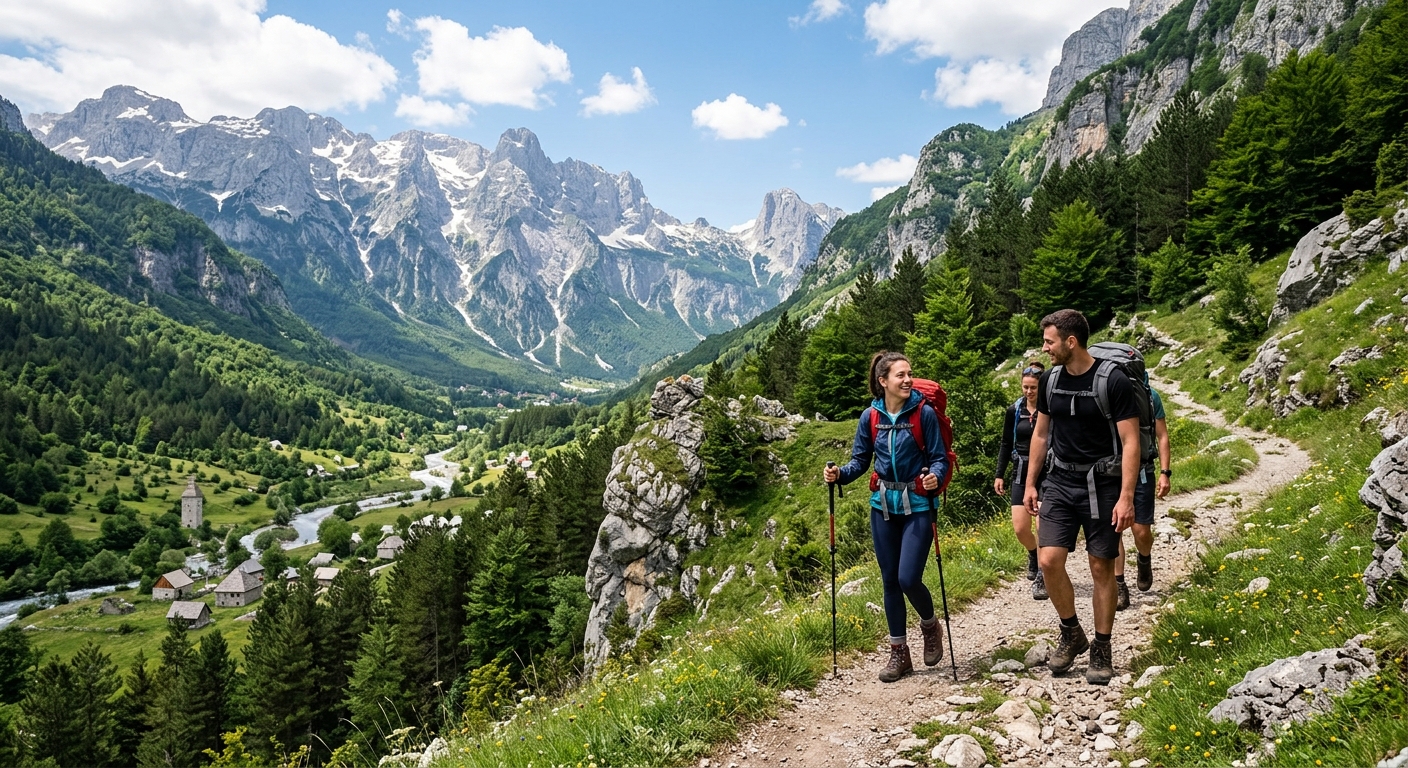
Hikers on a mountain trail above Theth valley

Plan a stay in Theth

One valley. Four ways to explore it.

Choose a practical 1–4 day itinerary, then adapt it to weather, fitness and current local advice.

Theth

Theth rewards travellers who slow down. Stone homes, family guesthouses and a small Catholic church sit beneath severe limestone peaks, while the river links the village to waterfalls, canyons and high passes. These plans combine the valley’s cultural landmarks with realistic mountain days.

1–4

day plans

16–18 km

Valbona crossing

1,700 m+

high-pass terrain

Choose your pace

1 day

The valley essentials

1

A compact cultural and nature introduction without committing to a full-day mountain route.

Morning · Old Theth

  • Walk between the church and the Reconciliation Tower. Opening hours are informal, so access should be confirmed locally.
  • Follow village lanes beside the river and observe the traditional stone houses without entering private land.

Afternoon · Grunas

  • Hike to Grunas Waterfall and a safe canyon viewpoint. The final approach is rocky and can be slippery.
  • Return before dark for a guesthouse dinner made with local produce.

2 days

Waterfalls & turquoise water

2

Adds a full outing through Nderlysaj to the Blue Eye.

Day 1 · Heritage and Grunas

  • Use the one-day valley plan: church, tower, waterfall and canyon.

Day 2 · Nderlysaj and Blue Eye

  • Walk or arrange road transport to Nderlysaj, then continue on foot to the Blue Eye.
  • Allow a full day if walking from central Theth—commonly about 17–18 km return. Pools and currents remain cold and potentially hazardous even in summer.

3 days

Culture, water & a high pass

3

A balanced stay with one demanding alpine objective.

Days 1–2 · Valley and Blue Eye

  • Complete the heritage, Grunas, Nderlysaj and Blue Eye programme at an unhurried pace.

Day 3 · Qafa e Pejës

  • Climb toward the 1,710–1,720 m Peja Pass for views of Arapi and the upper valley, returning by the same route.
  • This is a strenuous, exposed mountain day. Start early, carry ample water and turn back in unstable weather.

4 days

Theth to Valbona crossing

4

Finishes a complete Theth stay with the classic one-way pass crossing.

Days 1–3 · Explore Theth

  • Follow the three-day plan, or replace Qafa e Pejës with a rest day if saving energy for Valbona.

Day 4 · Theth–Valbona Pass

  • Cross roughly 16–18 km over Valbona Pass, with about 1,000–1,130 m of ascent from Theth. Arrange the next bed and luggage transfer before departure.
  • The route is busy in peak summer and can retain snow or receive sudden storms early in the season.

Before setting out

Arriving in Theth

Shared minibuses and transfers commonly leave Shkodër in the morning and take roughly two to three hours in good conditions. Historic fares such as €10 should not be treated as current; prices, departure points and schedules must be reconfirmed through accommodation or an operator. The paved mountain road allows self-driving, but bends are steep and parking should be agreed with the host. Theth can also be reached on foot from Valbona.

Where to stay

Family-run guesthouses are the characteristic form of accommodation and often include breakfast and dinner. Staying near the church is convenient for village sights; lodging toward Rrashkadoli or the Valbona trail offers quieter views but adds walking. Properties and standards change quickly, so no single guesthouse is presented as universally best. Reserve early in summer and confirm cash payment, meals and bathroom arrangements.

Season and conditions

June through October is the usual walking window, but no month guarantees clear trails. June may retain snow on passes; July and August bring heat and crowds; September is often quieter; October can bring cold nights and reduced services. Check forecasts and local trail reports immediately before each mountain day.

History with care

Theth’s church and fortified tower reflect the valley’s Catholic heritage and customary law. The tower is interpreted as a place associated with refuge during blood feuds and community mediation. Accounts of settlement dates, population and individual building uses vary; visitors should treat local museum interpretation and qualified historical sources as more reliable than repeated blog claims. Concrete bunkers in the wider Alps belong to Albania’s communist-era defence programme.

Mountain conditions outrank any itinerary

Distances and times are planning estimates, not guarantees. Confirm transport, openings and trail conditions locally, and carry an offline map.